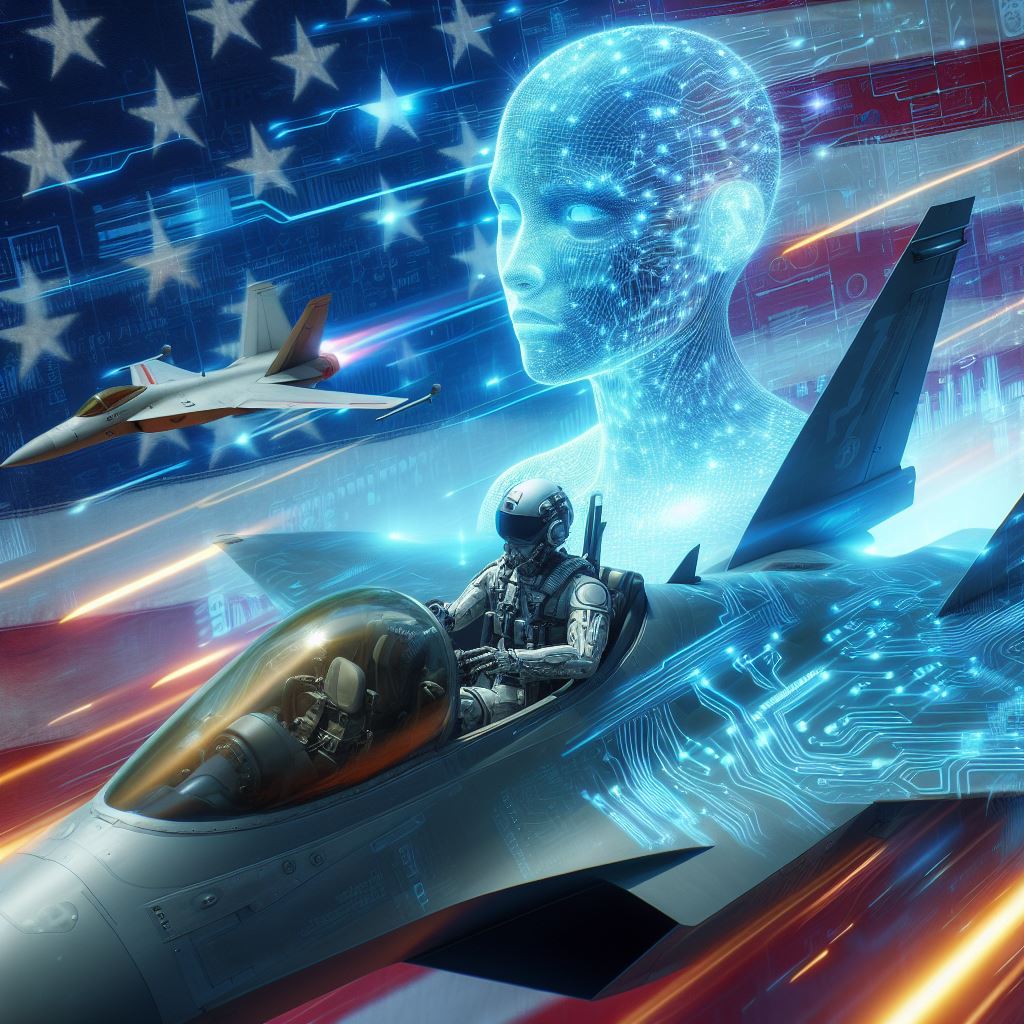
In a recent event in California, two Air Force fighter jets engaged in a dogfight, with a remarkable twist: one was piloted by a human, the other by artificial intelligence (AI), showcasing the Air Force's strides in technological innovation.
The AI-controlled jet, with the highest-ranking civilian of the Air Force on board, marks a significant development in military technology, tracing its origins back to the 1950s. However, this is just a glimpse of the vast potential AI holds for the future.
The United States and China are in a competition to harness AI for military applications, raising concerns about the prospect of autonomous machines engaging in warfare without direct human oversight. While U.S. officials assure that such scenarios won't materialize on their side, questions linger regarding adversaries' intentions.
Admiral Christopher Grady highlights the critical role AI will play in future battlefields, emphasizing China's active pursuit of AI technology.
AI in the military has evolved from basic machine learning to sophisticated autonomy. Early systems, like the Navy's Aegis missile defense, relied on human-programmed rulesets for autonomous action. However, they lacked the ability to learn and adapt from data.
The advent of big data and computing power in 2012 marked a significant advancement, allowing computers to generate rulesets independently. This era, termed AI's "big bang," ushered in a new era of AI-enabled autonomy.
Numerous AI projects are underway across the Pentagon, ranging from enhancing communication systems to developing AI alternatives for GPS navigation. MIT is actively involved in projects aimed at teaching AI to differentiate critical messages from routine cockpit chatter.
Another groundbreaking initiative involves using AI to navigate via Earth's magnetic fields, offering a GPS-independent solution for military operations.
Safety remains a top priority as AI is integrated into military operations. AI-controlled aircraft, like the F-16, undergo rigorous training with built-in safety features and a safety pilot to intervene if necessary.
AI's learning capabilities are accelerated through data analysis and simulation, allowing it to continually improve performance. However, controlling the data fed into the simulator is crucial for ensuring safe operation.
The Air Force envisions AI serving as the central intelligence for unmanned warplanes, heralding a new era of autonomous aerial warfare. Efforts are underway to train AI in understanding pilot communication, reflecting the intricate dynamics of command and control.
While AI promises to revolutionize military operations, maintaining human oversight and safety protocols remains paramount in its implementation.