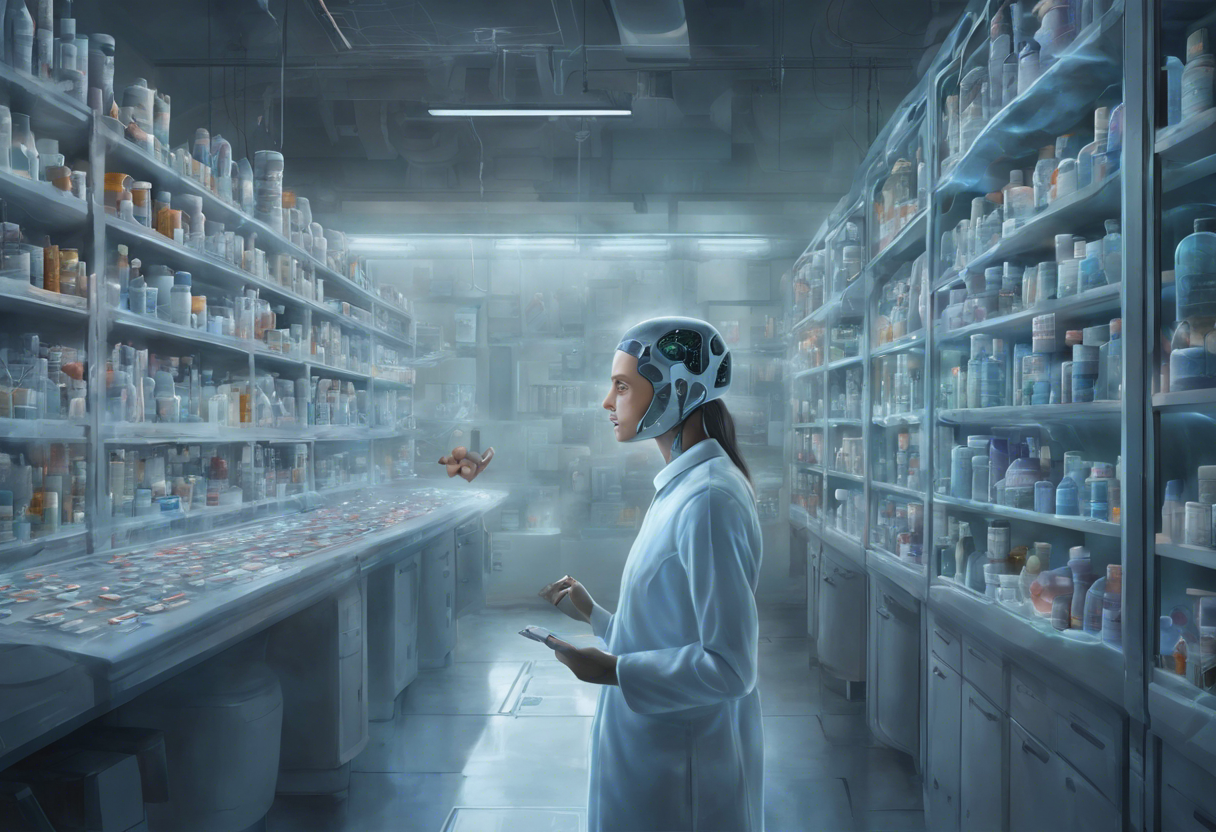
In a pivotal moment for artificial intelligence (AI) and its impact on diverse industries, a recent collaboration between researchers from LMU, ETH Zurich, and Roche Pharma Research and Early Development (pRED) Basel has unveiled an innovative AI-driven method that predicts optimal drug molecule synthesis. This breakthrough not only marks a turning point in the efficiency of chemical synthesis but also carries significant implications for the sustainability of pharmaceutical development.
The lead author of the groundbreaking study, David Nippa, emphasizes the potential of this method to streamline laboratory experiments, ultimately enhancing both efficiency and sustainability in chemical synthesis. Published in the prestigious journal Nature Chemistry, the research focuses on addressing the challenges posed by the modification and addition of functional groups to the frameworks of active pharmaceutical ingredients.
The method, centered around the borylation reaction, involves attaching a boron-containing chemical group to a carbon atom in the framework. This boron group serves as a precursor, allowing for the subsequent replacement with various medically effective groups. While promising, the borylation process is notoriously difficult to control in the laboratory setting.
To overcome this challenge, David Nippa and Kenneth Atz from ETH Zurich leveraged AI technology. They developed a sophisticated AI model trained on data sourced from reputable scientific works and experiments conducted in an automated lab at Roche. This model not only accurately predicts the optimal position for borylation in any given molecule but also provides the ideal conditions for the chemical transformation.
Remarkably, the accuracy of predictions increased when the AI model incorporated three-dimensional information about the starting materials, surpassing the limitations of traditional two-dimensional chemical formulas. This advancement demonstrates the power of AI in understanding complex molecular interactions and guiding chemical reactions with unprecedented precision.
The practical applications of this AI-driven approach are already evident. By successfully identifying positions in existing active ingredients where additional active groups can be introduced, researchers can expedite the development of new and more effective variants of known drug active ingredients. This accelerated drug discovery process holds tremendous potential for addressing medical needs more rapidly and efficiently.
As the AI community continues to push boundaries, this breakthrough in drug synthesis serves as a beacon for the future of sustainable chemistry. By reducing the number of required lab experiments and enhancing the predictability of chemical reactions, AI is proving to be a game-changer in pharmaceutical research, promising a more sustainable and efficient approach to drug development.