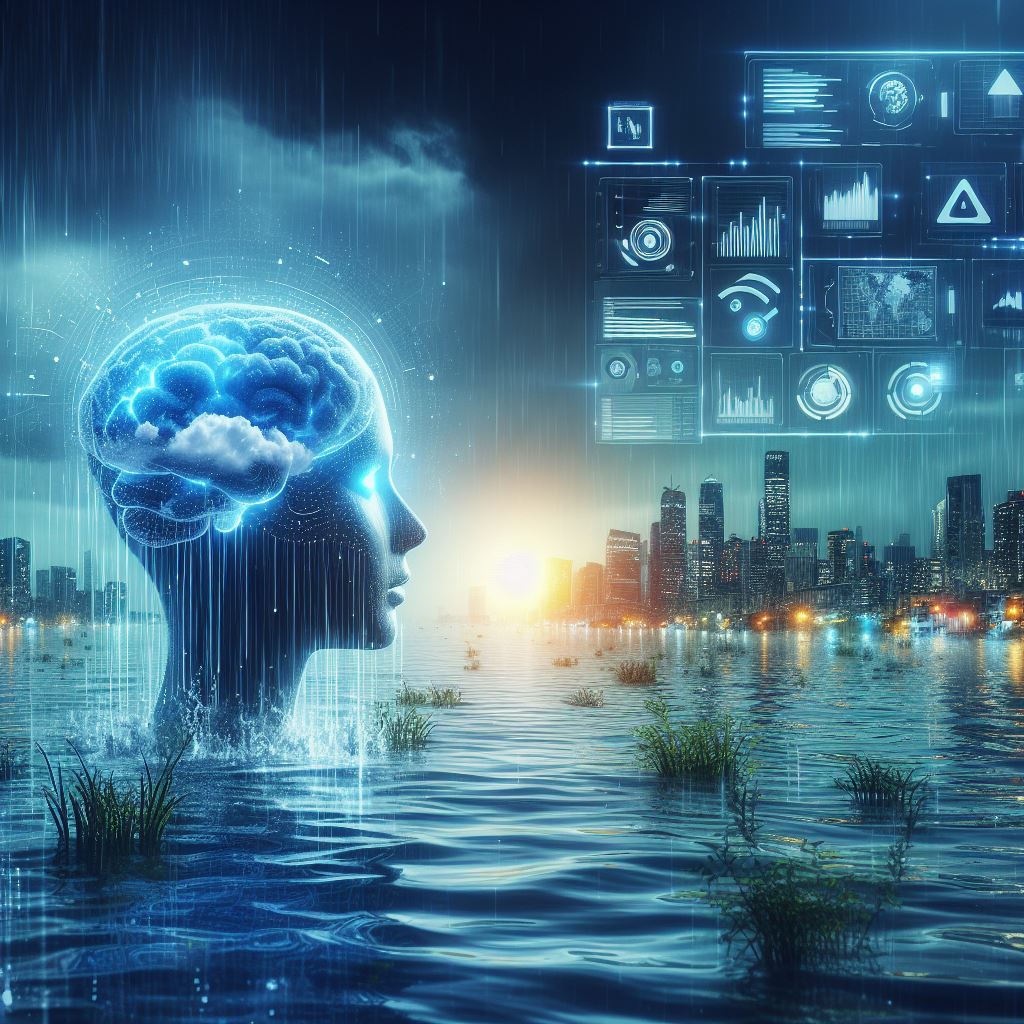
Flooding poses a significant threat to lives and property globally, affecting over 1.81 billion people, according to a recent World Bank report. The escalating risk, attributed to climate change, has prompted innovative solutions to predict and mitigate flood damage.
To address this growing concern, companies like 7Analytics in Bergen, Norway, are leveraging artificial intelligence (AI) to provide real-time flood predictions. By analyzing weather forecasts, geography, land use, and drainage capacity, 7Analytics claims to forecast flooding events up to seven days in advance, offering detailed information on affected areas.
"We can actually predict, based on the weather forecasts up to seven days in advance, what flooding will happen, and it's down to the very finest grain," says Jonas Torland, co-founder of 7Analytics.
London-based Neara is another player in this field, using AI to create digital flood simulations tailored for the electricity infrastructure industry. These simulations assist power networks in preparing for potential floods, minimizing damage and aiding in the swift restoration of power.
"With unpredictable flooding, I think loss of electricity is one of the most significant sources of devastation," says Mary Cleary, Chief Marketing Officer at Neara.
Meanwhile, Google's Flood Hub platform offers free river flood warnings in over 80 countries, utilizing thousands of satellite images and AI simulations to predict river flooding after heavy rainfall. The platform claims to provide warnings between two and seven days in advance, enabling timely evacuations and preventive measures.
"Floods are one of the most devastating natural disasters, and impact hundreds of millions of people per year," says Yossi Matias, Vice President of Engineering and Research and Crisis Response Lead at Google.
While these AI-driven solutions hold promise, experts emphasize the importance of reliable data for effective predictions. Dr. Amy McGovern, a computer scientist at the University of Oklahoma School of Meteorology, highlights the need for extensive data to train AI models and cautions against potential biases.
"The models are only as good as the data that they collect," says Dr. McGovern. "The key part of being trustworthy is making sure that you are responsible and ethical in your AI development, and that you're paying attention to the biases in your data."
Despite these challenges, the use of AI in flood prediction is seen as a game-changer, enabling faster and more accurate assessments. Optimism surrounds the potential of AI to revolutionize flood prediction, ensuring communities are better prepared for natural disasters and minimizing the loss of lives and property.