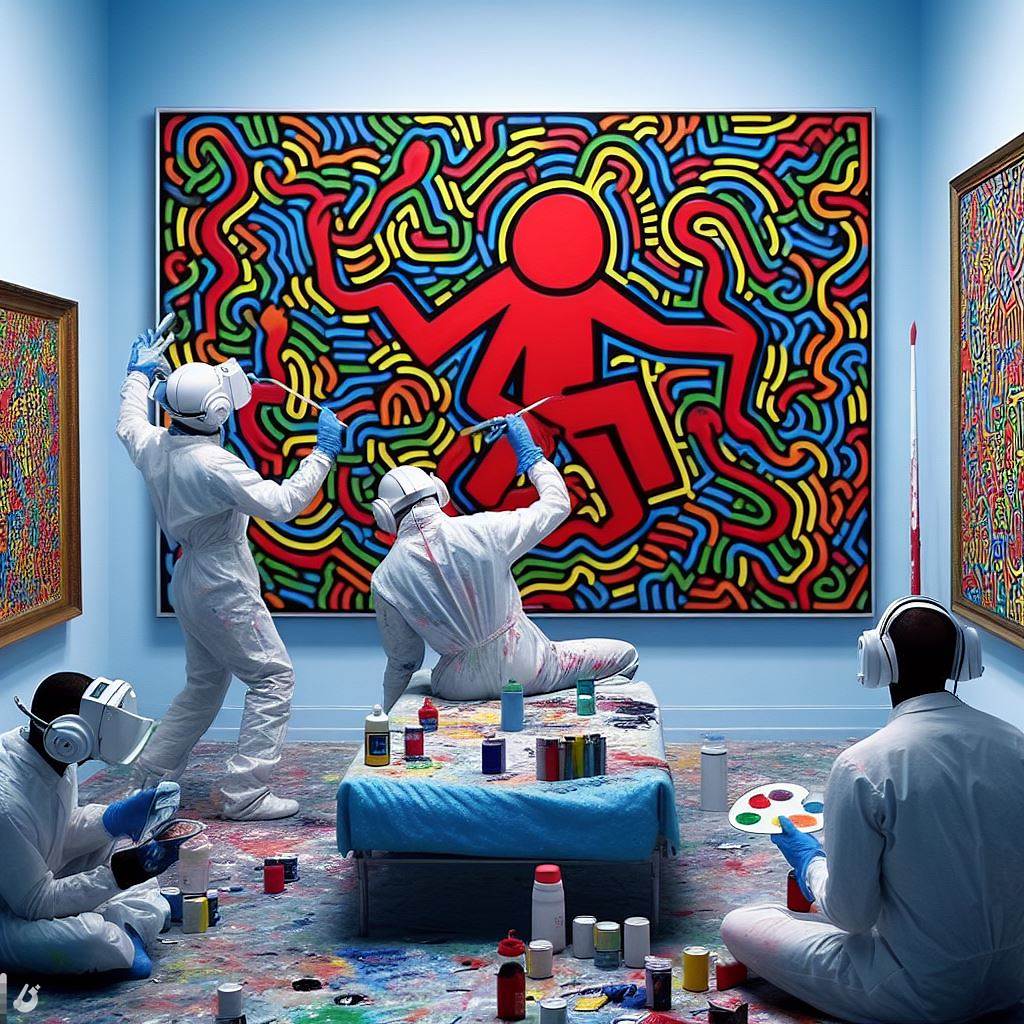
Renowned artist Keith Haring's "Unfinished Painting," a poignant reflection on the AIDS crisis, became the center of controversy when a social media user employed artificial intelligence (AI) to "complete" the artwork. The move triggered online outrage among artists who argue that the use of AI has compromised the original meaning of the piece.
Haring, who succumbed to AIDS-related complications in 1990 at the age of 31, left behind an artwork on an almost entirely white canvas, adorned only in the right corner with colorful figures in his distinctive style, alongside streaks of paint running down from that corner.
The controversial AI transformation occurred when a user named Donnel shared an altered version of the painting, filling the original white space with similar purple and white figures. The post quickly went viral, prompting backlash from those who deemed the use of AI to complete a deceased artist's work as unethical and a potential threat to the authenticity of artistic expression.
The controversy highlights the growing accessibility of AI programs, such as OpenAI’s ChatGPT and Microsoft’s Bing AI Chat, enabling individuals to create sophisticated images and texts with simple prompts. Artists like Megan Ruiz express concern that these AI models are often trained on stolen work, raising ethical issues related to consent, plagiarism, and compensation.
Megan Ruiz and another artist, Brooke Peachley, criticized Donnel's AI rendition on social media platforms, emphasizing their existing concerns about the intersection of art and AI. The controversy sparked a wider discussion on platforms like Reddit, with some users labeling AI-generated art as "vile" and "disgusting."
Despite accusations of homophobia and claims that the AI failed to replicate Haring's unique style, Donnel defended their post as a joke when contacted for an interview, choosing to remain anonymous to avoid potential online backlash.
The Keith Haring Foundation, responsible for overseeing the artist's intellectual property, has not yet commented on the controversy. The foundation emphasizes its commitment to preserving Haring's legacy and requires prior authorization for any use of his artwork.
Experts suggest that while Donnel may not have violated any legal boundaries, the ethical implications of using AI on Haring's work are significant. Tina Tallon, an assistant professor of AI and the arts at the University of Florida, emphasizes the need for education on ethical AI use, asserting that current structures lack frameworks for fully respecting the agency of artists over their creative work, whether living or dead.
In conclusion, the controversy surrounding Keith Haring's "Unfinished Painting" and its AI completion underscores the ethical challenges and growing concerns within the artistic community regarding the use of AI in altering or completing original works.