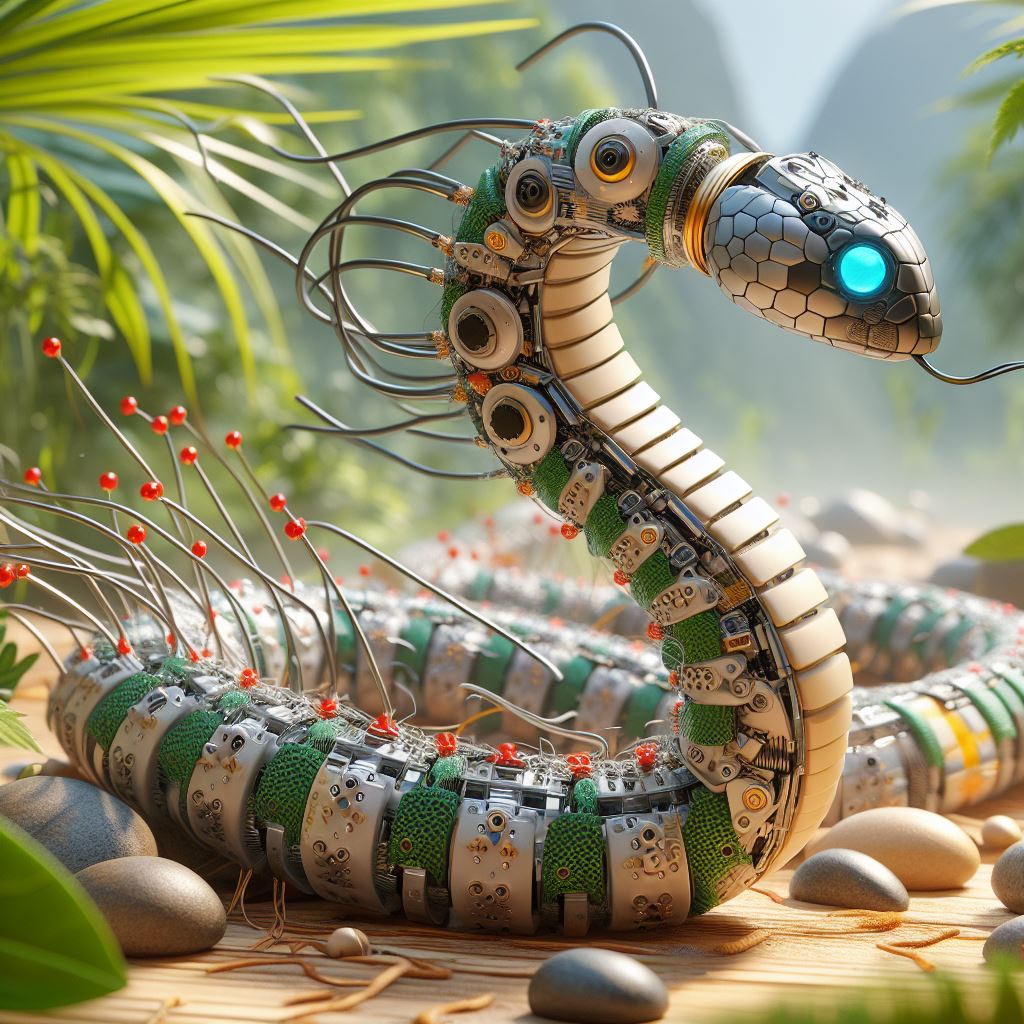
Researchers from Lancaster University, Beijing Institute of Technology, and North China University of Technology have developed a groundbreaking strategy to improve the functionality of snake-like robotic systems. Published in the journal Bioinspiration & Biomimetics, the study focuses on optimizing the stiffness of these robots, addressing a longstanding challenge in their deployment.
Snake-like robots, drawing inspiration from nature, offer unique advantages in navigating challenging environments. With their flexible bodies and sliding motions, they can access confined spaces, such as pipes and mines, where conventional systems face limitations.
Despite their potential, large-scale deployment of snake robots has been hindered by difficulties in effectively modulating their stiffness, impacting precision and utility. To address this issue, the research team proposed a novel 'macro–micro' structure and a comprehensive stiffness regulation strategy, applied to a snake-like robotic arm with 20 degrees of freedom (DoF).
In their paper, the researchers highlighted the significance of their approach: "Snake robots have been widely used in challenging environments, such as confined spaces. However, most existing snake robots with large length/diameter ratios have low stiffness, limiting their accuracy and utility. To remedy this, a novel 'macro–micro' structure aided by a new comprehensive stiffness regulation strategy is proposed in this paper."
The macro–micro structure enhances the positional accuracy of snake-like robots navigating confined spaces above and below the ground. Additionally, a kinetostatic model was developed to estimate errors in the robot's movements.
The team incorporated factors like internal friction and cable stiffness variation into the model to increase accuracy. Experimental validation on a physical prototype and control system yielded promising results, with errors of 4.3% and 2.5% for straight and curved configurations, respectively.
The researchers applied their design strategy to develop a prototype system, demonstrating its effectiveness in initial tests. Their strategy enabled them to adjust cable tension, influencing the snake-like arm's motions by an average of 183.4%.
This breakthrough in stiffness regulation has significant implications for the future of snake-inspired robotic systems. The enhanced precision and modulability of these robots could prove invaluable in search and rescue operations, monitoring underground environments, and various other real-world applications. As technology advances, the potential for these bio-inspired systems to efficiently tackle complex and confined missions continues to grow.