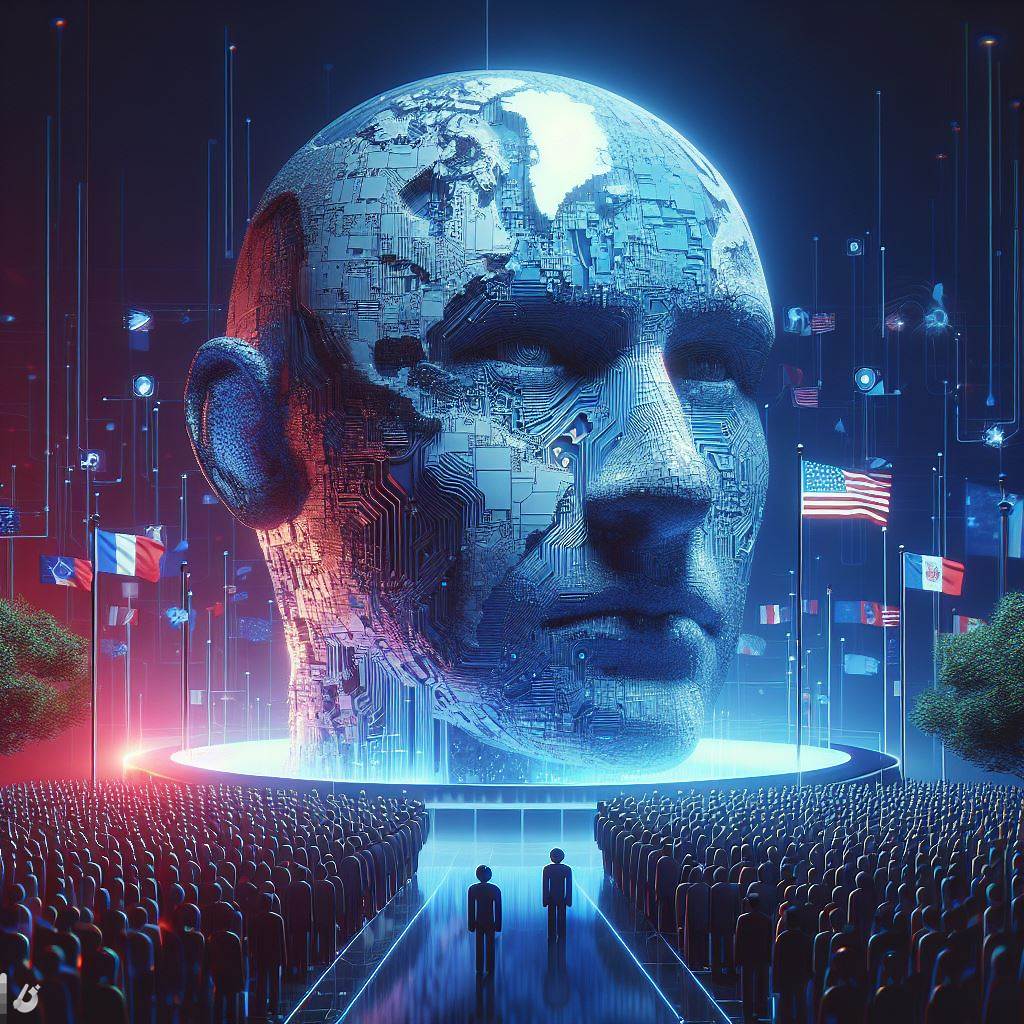
In a recent video, former US presidential candidate Hillary Clinton endorses Republican Ron DeSantis, a surprising move that investigation reveals was facilitated by generative artificial intelligence (AI). This example highlights the potential impact of AI-generated content on politics, as experts warn of the looming risks for elections worldwide.
2023 witnessed the emergence of generative AI reshaping political landscapes. The technology's consequences include the production of false information at minimal cost and the creation of highly personalized, manipulative political advertising. Experts express concerns about the possibility of "October surprises," where misinformation circulates just before elections, leaving insufficient time for refutation. Additionally, misleading information about electoral administration could influence voter behavior.
The urgency of addressing generative AI's impact on elections grows as billions of people are set to vote in 2024 across several nations, including Taiwan, India, Russia, South Africa, Mexico, Iran, Pakistan, Indonesia, the European Union, the US, and the UK. The widespread use of generative AI technologies during this period parallels the influence social media had on elections in the 2010s.
While social media required substantial financial investment, generative AI significantly reduces the cost of producing misleading information to almost zero. The term "botshit" is coined to describe the potential rise of AI-generated content intended to persuade without regard for truth. Experts warn that this phenomenon could exacerbate the challenges posed by misleading information in politics.
A recent paper by Tim Hannigan, Ian McCarthy, and André Spicer delves into the concept of botshit, emphasizing the risk associated with generative AI's ability to produce inaccuracies or "hallucinations." These hallucinations, superficially plausible but often incorrect, could lead to a distorted understanding of reality, especially when addressing crucial and challenging-to-verify questions.
The consequences become particularly severe when AI-produced hallucinations influence vital decisions, such as economic conditions or geopolitical events. The danger lies in creating an environment where voters base decisions on illusory information, contributing to a distorted online reality fueled by a blend of AI hallucinations and political motives.
While acknowledging the potential dangers, experts suggest practical measures to mitigate risks. Technology companies can implement watermarking for easy identification of AI-generated content. Ensuring AIs are trained on authoritative information sources and journalists avoiding coverage of AI-generated stories during election cycles are also recommended. Political parties are urged to develop policies preventing the use of deceptive AI-generated information. Most importantly, voters are encouraged to exercise critical judgment by fact-checking information they find dubious.
As generative AI continues to reshape various industries, including politics, it is crucial to navigate its applications carefully. While the Brookings Institution highlights positive uses, addressing and preventing negative impacts is imperative to avoid the proliferation of "botshit" in the political sphere.