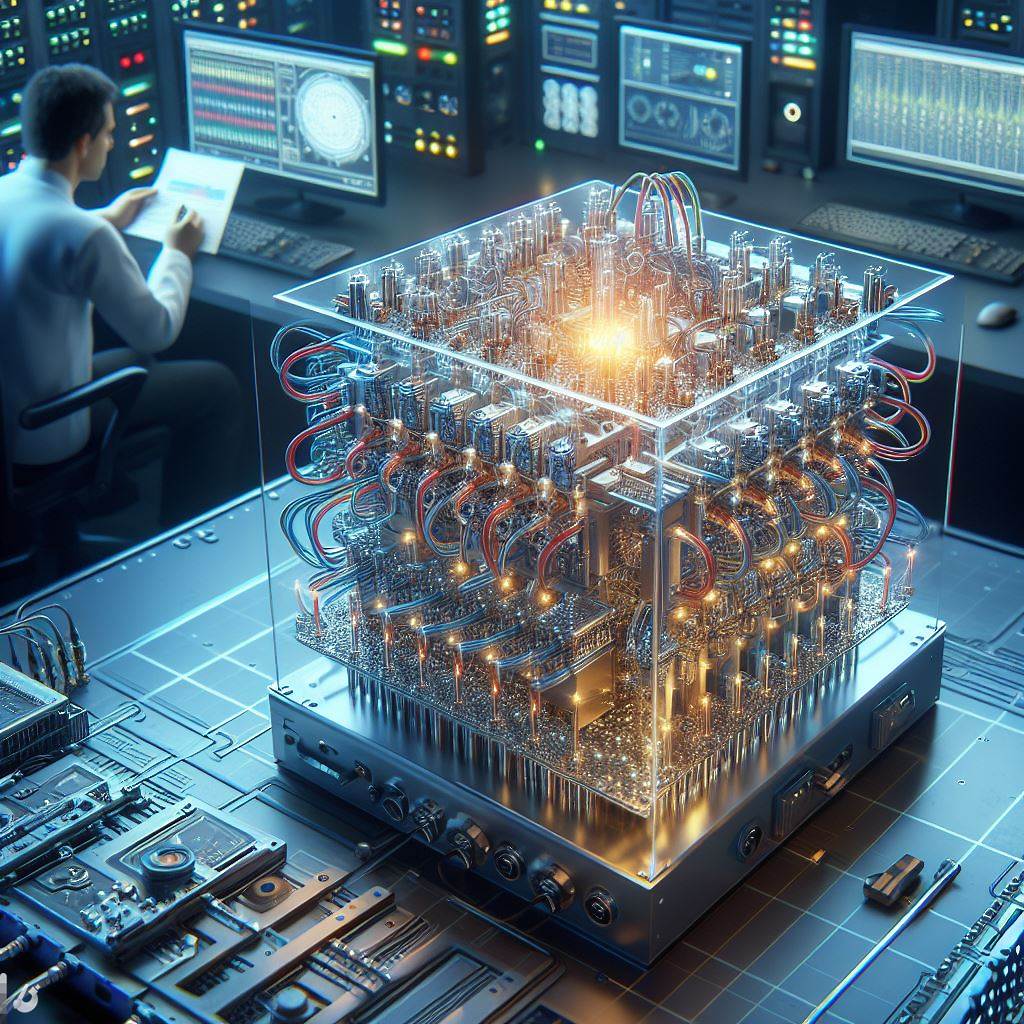
In a groundbreaking revelation, researchers from Tohoku University and the University of California, Santa Barbara, have presented a proof-of-concept for an energy-efficient computer tailored for contemporary AI applications. Unveiled at the IEEE International Electron Devices Meeting (IEDM 2023) on December 12, 2023, the innovation centers around the utilization of nanoscale spintronics devices with stochastic behavior, specifically designed to address probabilistic computation problems such as inference and sampling.
The need for domain-specific hardware has surged in the wake of Moore's Law plateauing. A key highlight of this development is the introduction of a probabilistic computer employing naturally stochastic building blocks, known as probabilistic bits (p-bits). These p-bits offer promising capabilities in handling computationally challenging tasks within machine learning (ML) and artificial intelligence (AI).
Much like quantum computers align with inherently quantum problems, the researchers emphasize that room-temperature probabilistic computers are apt for intrinsically probabilistic algorithms. These algorithms play a crucial role in training machines and solving complex problems in optimization and sampling within the AI landscape.
The researchers showcased the efficiency of robust and fully asynchronous (clockless) probabilistic computers at scale, achieved by incorporating a probabilistic spintronic device called stochastic magnetic tunnel junction (sMTJ) with powerful Field Programmable Gate Arrays (FPGA). Until now, sMTJ-based probabilistic computers had been limited to implementing recurrent neural networks, leaving a gap in implementing feedforward neural networks, crucial for many modern AI applications.
Professor Kerem Camsari, the Principal Investigator at the University of California, Santa Barbara, underscored the significance of advancing probabilistic computers towards implementing feedforward neural networks. This, he suggests, is a pivotal step in not only entering the market but also in enhancing the computational prowess of AI applications.
The breakthrough presented at IEDM 2023 marks two critical advancements. First, by leveraging prior work on stochastic magnetic tunnel junctions, the researchers demonstrated the fastest p-bits at the circuit level, operating at a speed approximately three orders of magnitude faster than previous reports. Second, by enforcing an update order at the hardware level and employing layer-by-layer parallelism, the researchers illustrated the basic operation of the Bayesian network—a key example of feedforward stochastic neural networks.
Although the current demonstrations are on a small scale, the researchers are optimistic about scaling up these designs. By harnessing CMOS-compatible Magnetic RAM (MRAM) technology, they envision significant strides in machine learning applications and the efficient realization of deep/convolutional neural networks. Professor Shunsuke Fukami, the principal investigator at Tohoku University, emphasized the potential for this breakthrough to unlock new horizons in AI, pushing the boundaries of what was once deemed computationally challenging.