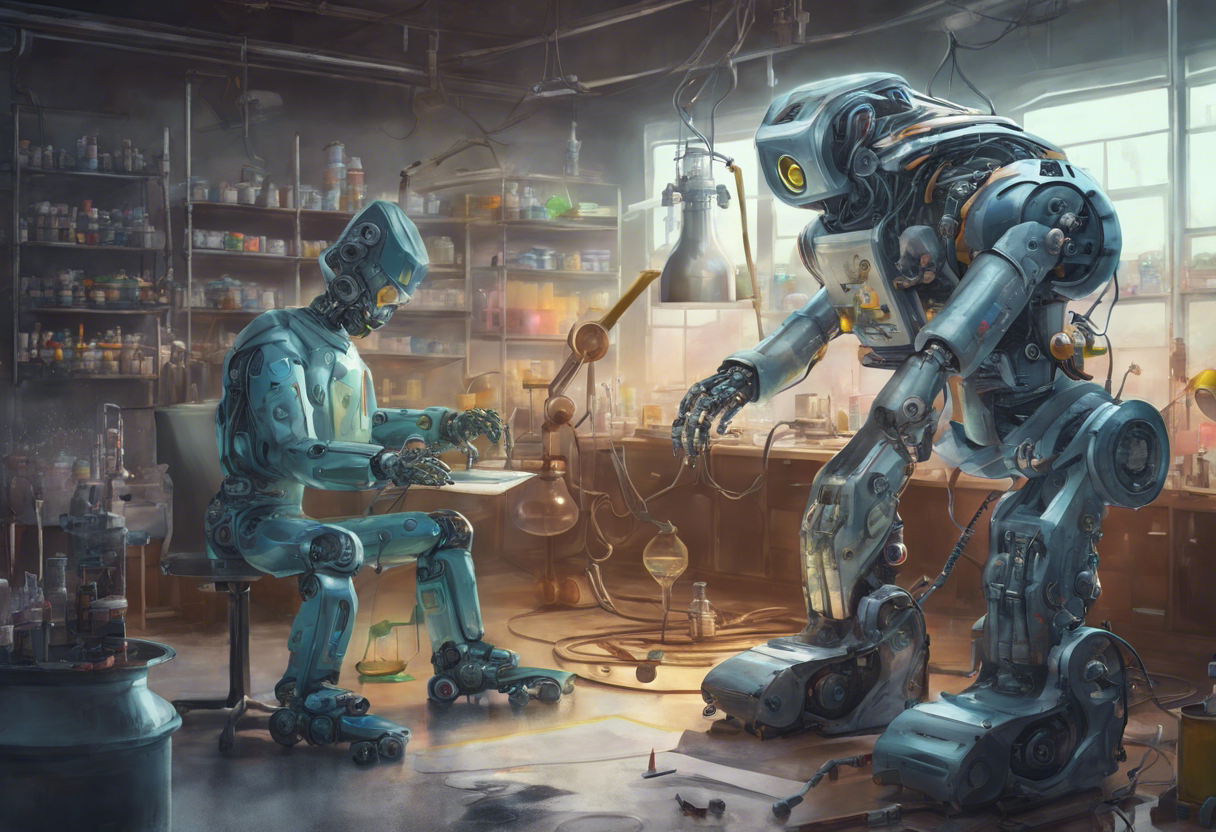
In a groundbreaking development, an autonomous system, the A-Lab, is marrying robotics with artificial intelligence (AI) to revolutionize material discovery. The A-Lab has recently unveiled its inaugural set of discoveries, marking a significant leap towards accelerating advancements in clean-energy technologies, next-gen electronics, and various other applications. Simultaneously, the GNoME AI system, developed by Google DeepMind, has predicted hundreds of thousands of stable materials, providing the A-Lab with a vast pool of potential candidates for future exploration.
AI's Foray into Scientific Discovery
Carla Gomes, co-director of the Cornell University AI for Science Institute, highlights the excitement surrounding the integration of AI into scientific discovery. She asserts that AI's entry into this domain is the next frontier, underscoring the potential impact on technologies such as batteries and solar cells through the discovery of superior materials.
Supersizing Material Discovery with GNoME
Traditionally, chemists have meticulously synthesized a few hundred thousand inorganic compounds over centuries. However, studies indicate that there are still billions of undiscovered inorganic materials. To address this challenge, the GNoME AI system, drawing on data from the Materials Project and similar databases, has generated a staggering 2.2 million potential compounds. After rigorous stability calculations and crystal structure predictions, GNoME has added 381,000 new inorganic compounds to the Materials Project database. Notably, GNoME employs innovative tactics to predict more materials than its predecessors, presenting a paradigm shift in materials discovery.
A-Lab: Bridging the Gap from Prediction to Reality
While predicting the existence of materials is crucial, bringing them to life in the lab is an entirely different challenge. This is where the A-Lab, equipped with state-of-the-art robotics, comes into play. Developed by Gerbrand Ceder and his team, the A-Lab autonomously executes the synthesis of materials, eliminating the need for human intervention. The system can rapidly produce new materials conceived computationally, showcasing its potential to transform the landscape of material synthesis.
Active Learning and the Indefatigable Robot
The A-Lab's ingenuity lies in its autonomous decision-making capabilities. By identifying stable compounds from the Materials Project database, cross-referencing them with the GNoME database, and leveraging machine-learning models, the A-Lab plans experiments, interprets data, and continually refines its synthesis procedures. The active learning algorithm plays a pivotal role, devising improved procedures when necessary. In just 17 days, the A-Lab successfully produced 41 new inorganic materials, with 9 created after active learning interventions.
Challenges and Future Prospects
While AI systems like GNoME can generate numerous computational predictions, challenges remain in accurately calculating the chemical and physical properties of these materials. Andy Cooper from the University of Liverpool emphasizes the need for AI systems to guide material creation accurately.
A-Lab's Legacy: A Map of Reactivity
The A-Lab continues its operations, contributing its results to the Materials Project. Gerbrand Ceder envisions this growing database as the system's greatest legacy—a comprehensive map of the reactivity of common solids. This repository of knowledge holds the potential to change the world, not just through the A-Lab itself but through the invaluable information it generates.
In conclusion, the fusion of robotics and AI in material discovery, exemplified by the A-Lab and GNoME, signifies a transformative era in scientific exploration. As these autonomous systems unlock new possibilities, the future holds exciting prospects for advancements in clean energy, electronics, and beyond.