ChatGPT is based on Transformer architecture. It is a neural network architecture for processing sequential data, such as text. It was introduced in the 2017 paper “Attention is All You Need”. The Transformer architecture is based on self-attention mechanisms, which allow the model to weigh the importance of different parts of the input sequence when making predictions.
The following is a detailed explanation of the Transformer architecture:
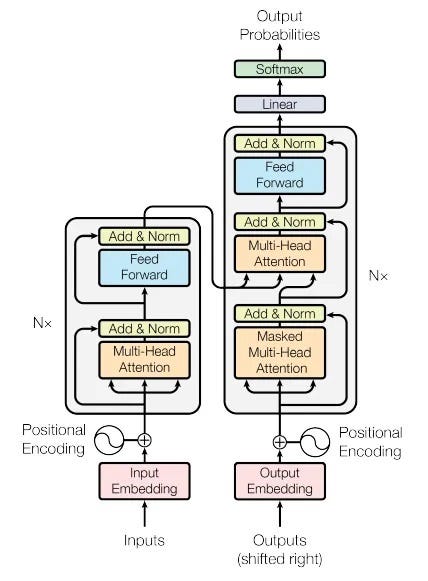
Input Sequence (Inputs): The input sequence is a sequence of tokens (e.g., words or sub-words) that represent the text input.
Input Embedding:sequence into a matrix of vectors, where each vector represents a token in the sequence. This process is called input embedding. The input embedding layer maps each token to a high-dimensional vector that captures the semantic meaning of the token.
Self-Attention Mechanism: The self-attention mechanism allows the model to compute relationships between different parts of the input sequence. It consists of three steps: query, key, and value computations, and attention computation. In the query, key, and value computations, the input vectors are transformed into three different representations using linear transformations. In the attention computation step, the model computes a weighted sum of the values, where the weights are based on the similarity between the query and key representations. The weighted sum represents the output of the self-attention mechanism for each position in the sequence.
Multi-Head Self-Attentionmodel to focus on different parts of the input sequence and compute relationships between them in parallel. In each head, the query, key, and value computations are performed with different linear transformations, and the outputs are concatenated and transformed into a new representation.
Feedforward Network: The output of the multi-head self-attention mechanism is fed into a feedforward network, which consists of a series of fully connected layers and activation functions. The feedforward network transforms the representation into the final output.
Layer Normalization (Add & Norm Layer): The activations in each layer of the Transformer architecture are normalized using layer normalization, which helps stabilize the training process and prevent the model from overfitting. A residual connection followed by layer normalization, which helps to stabilize the training process and make the model easier to train.
Positional Encoding: To capture the order of the tokens in the input sequence, a positional encoding is added to the input embedding. The positional encoding is a vector that represents the position of each token in the sequence.
Stacking Layers: The Transformer architecture can be stacked to form a deep neural network by repeating the multi-head self-attention mechanism and feedforward network multiple times.
Output: The final output from the Transformer, which is a vector representation of the input sequence.
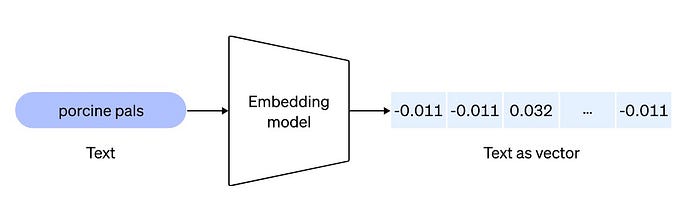 Embeddings are numerical representations of concepts converted to number sequences, which make it easy for computers to understand the relationships between those concepts. Since the initial launch of the OpenAI /embeddings endpoint, many applications have incorporated embeddings to personalize, recommend, and search content.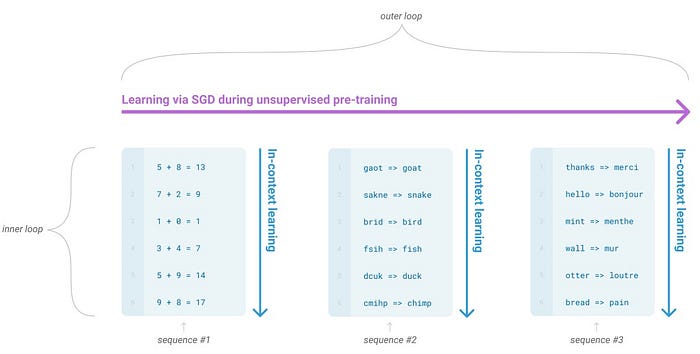
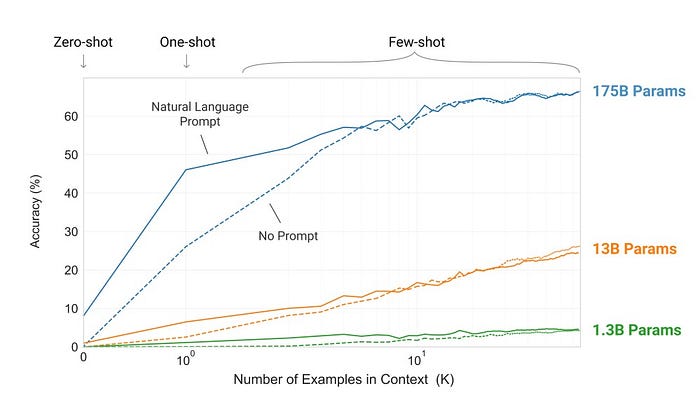 Larger models make increasingly efficient use of in-context information. In-context learning performance on a simple task requiring the model to remove random symbols from a word, both with and without a natural language task description. The steeper “in-context learning curves” for large models demonstrate improved ability.