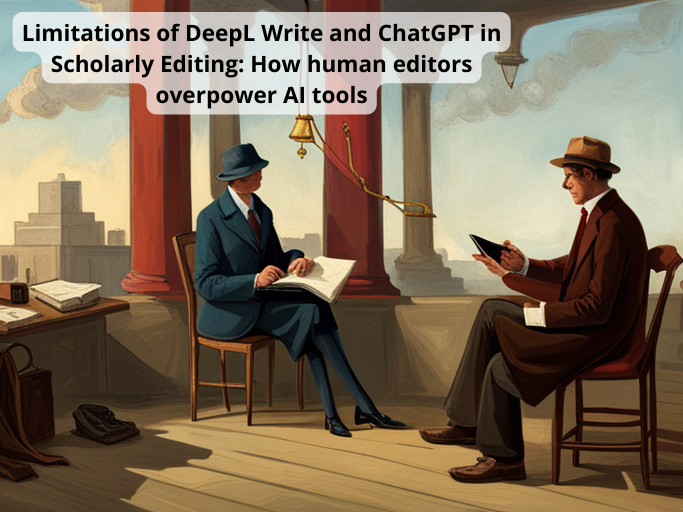
When editing your scholarly work, the choice among DeepL Write, ChatGPT, and human editors can greatly impact your academic reputation.
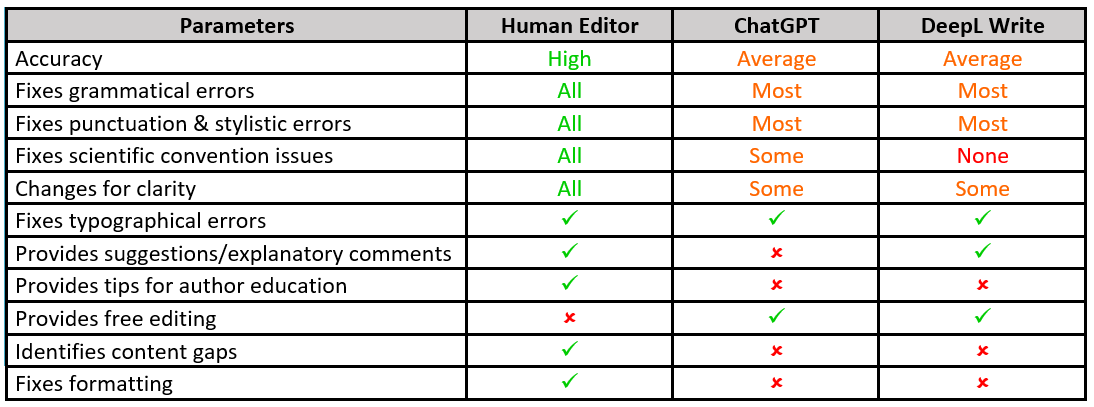
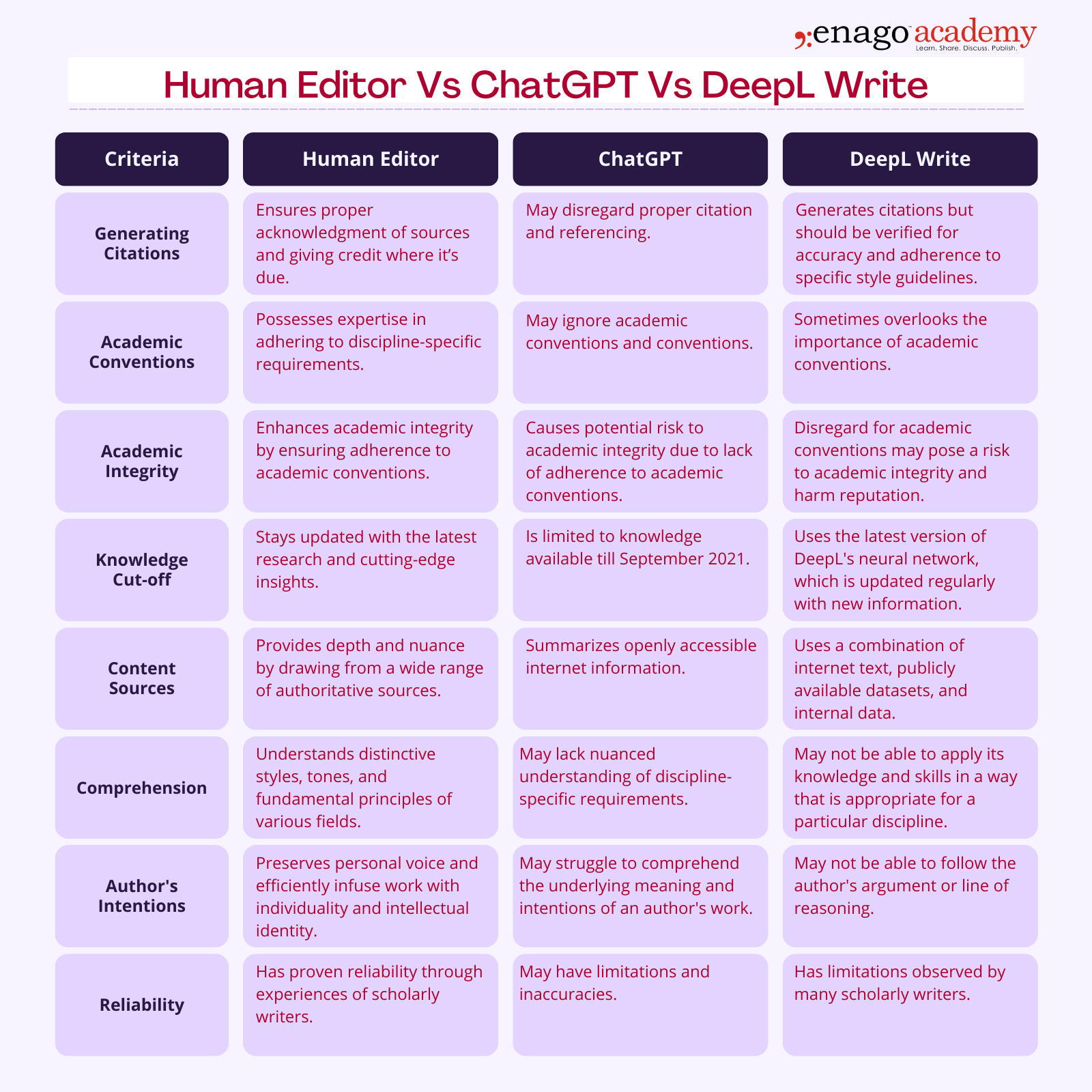
Human Editor Vs ChatGPT Vs DeepL Write: Comparison of different aspects
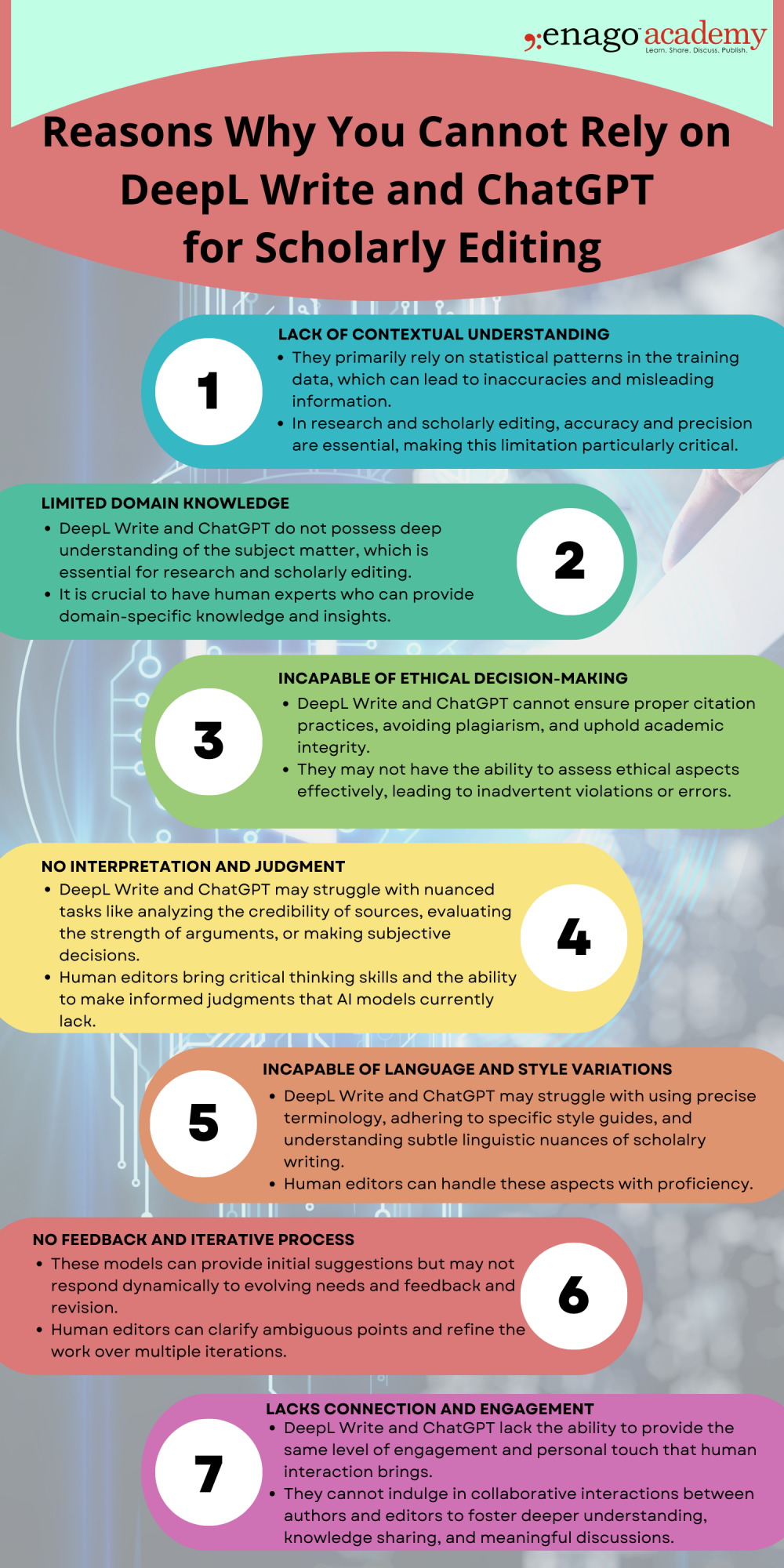
 Why You Cannot Rely on DeepL Write and ChatGPT for Academic Editing
AI technologies may have made significant advancements in natural language processing (NLP) and machine learning (ML), there are several reasons why relying solely on
AI tools like DeepL Write and ChatGPT for these tasks may not be the best approach.
While these technologies have demonstrated remarkable capabilities in natural language processing, they have notable limitations in research and scholarly editing.
DeepL Write and ChatGPT can support several tasks by providing initial suggestions and automating certain processes; however, human editors remain indispensable for ensuring accuracy, critical thinking, ethical standards, and meaningful engagement.
Examples and Error Explanations of DeepL Write Vs ChatGPT Vs Human Editing
Example 1Original TextEdited by DeepL WriteEdited by ChatGPTEdited by a Human (Enago Editor)Example 2Original TextEdited by DeepL WriteEdited by ChatGPT
Edited by a Human (Enago Editor)Example 3Original TextEdited by DeepL WriteEdited by ChatGPTEdited by a Human (Enago Editor)These observations highlight the limitations in the capabilities of ChatGPT & DeepL Write, leading to the inference that these language models have difficulty in accurately editing scholarly work.
Comparative Analysis of Human Editing Vs ChatGPT Vs DeepL Write Editing
Balancing Human and Artificial Intelligence in Scholarly EditingAchieving a balance between AI and human involvement in research and scholarly editing is crucial to leverage the strengths of both approaches while mitigating their limitations. Moreover, by combining the capabilities of AI technologies with human expertise, critical thinking, and judgment, it is possible to enhance the quality, efficiency, and effectiveness of these processes..
Proofreading and Grammar CheckingUse AI tools like DeepL Write and ChatGPT to quickly identify and correct errors in grammar, spelling, and punctuation of general writing.
Review and double-check the AI-generated suggestions to ensure accuracy and context appropriateness.
Furthermore, pay attention to their recommendations for sentence structure and clarity, as they could change the author’s voice and messaging.
2. Language TranslationUtilize DeepL Write for quick translations of research papers or scholarly articles.
Review and refine the DeepL Write generated translations for accuracy and nuances specific to the target language and subject area.
Use DeepL Write translation as a starting point, but rely on human editors for final polishing and ensuring the translated text maintains coherence and clarity.
3. Citation FormattingTake advantage of these AI tools to automatically format citations.
Verify the accuracy and completeness of the citations generated with the help of DeepL Write, ChatGPT, or any other AI tool by cross-referencing them with official style guides or manuals.
Moreover, familiarize yourself with these tools’ formatting capabilities and any specific requirements or limitations it may have for citation formatting.
4. AI-assisted Data AnalysisProcess large datasets and identify patterns, correlations, and trends that may be challenging to detect manually.
Verify the results and insights through statistical analysis and validation techniques.
In addition, combine insights by DeepL Write and ChatGPT with human interpretation and expertise to draw meaningful conclusions and make evidence-based decisions.
5. Contextual Understanding and InterpretationCollaborate with human experts who possess domain-specific knowledge to ensure accurate interpretation of research findings.
Also, engage in discussions and seek clarifications from authors or researchers to grasp complex concepts and contextual information.
Finally, consider historical, cultural, and social contexts while interpreting and evaluating the relevance and integrity of the research.
6. Ethical Considerations and BiasMaintain a thorough understanding of ethical guidelines and academic integrity standards to detect and address potential ethical issues.
Use DeepL and ChatGPT to identify potential instances of plagiarism or improper citation, but rely on human editors to evaluate the context and intent.
Be vigilant in recognizing and mitigating biases, both in the research content and within the AI tools themselves (after all, they are all trained on almost the same data!).
7. Collaboration and EngagementActively engage with authors, researchers, and peers throughout the editing process to foster collaboration and effective communication.
Seek constructive feedback and guidance from human editors to enhance your work and consider diverse perspectives.
Additionally, use collaborative platforms and tools that facilitate real-time communication and document sharing to streamline the editing workflow.
8. Critical Thinking and CreativityEmphasize critical analysis and creative problem-solving during the editing process to generate original ideas and insights.
Challenge the suggestions given by DeepL Write and ChatGPT, and explore alternative approaches to strengthen arguments and enhance your research’s impact.
Additionally, think critically and contribute your unique perspectives, ensuring that the research goes beyond automated text generation.
By combining the strengths of AI and human editors, we can optimize the quality, integrity, and impact of research and scholarly editing, while ensuring that human expertise and judgment remain at the forefront.
Salient Insight on Human Editing Vs DeepL Write Vs ChatGPTFinally, although ChatGPT and DeepL Write have made notable advancements in natural language processing, the observations provide strong evidence of their limitations in accurately editing scholarly work. Furthermore, these tools fail to correct technical jargon, understand context, rectify typos, produce concise and clear sentences, and grasp domain-specific knowledge.
They may misinterpret or overlook crucial errors, leading to inaccuracies or further mistakes in their generated edits.
On the other hand, human editors proficiently edit and revise scholarly work with their unparalleled expertise, and thus continue to remain indispensable against AI tools like DeepL Write and ChatGPT.
 Edited by DeepL Write
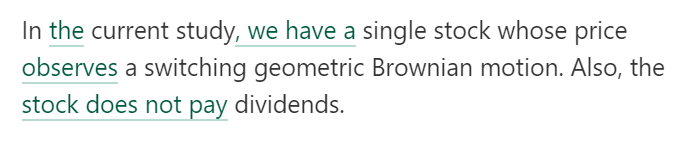 Edited by ChatGPT

 Edited by DeepL Write
 Edited by ChatGPT

 Edited by DeepL Write
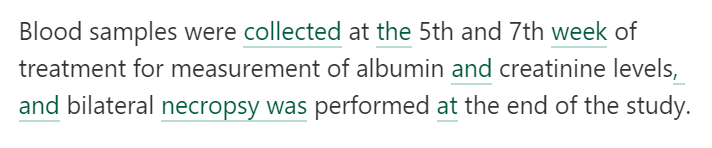 Edited by ChatGPT